
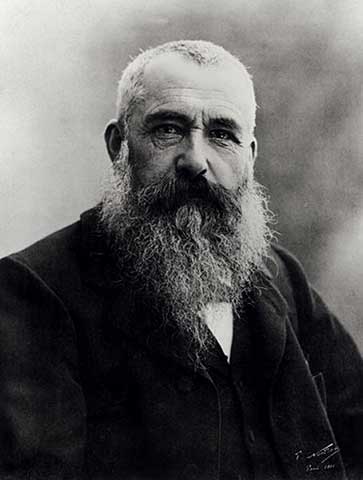
Claude Monet was a founder of French impressionist painting.
He was the most consistent and prolific practitioner of the movement's philosophy of expressing
one's perceptions before nature, especially as applied to plain-air
landscape painting.
The term Impressionism is derived from the title of his painting Impression, Sunrise.
Monet was born on November 14, 1840 in Paris. 1851, Monet entered the Le Havre secondary school of the arts.
He was 16 years old when he left school, and went to live with his aunt, Marie-Jeanne Lecadre.
Monet was in Paris for several years and met several painters who would become friends and fellow impressionists.
Disillusioned with the traditional art taught at universities, in 1862 Monet became a student of Charles Gleyre
in Paris, where he met Pierre-Auguste Renoir, Frederic Bazille, and Alfred Sisley. Together they shared new
approaches to art, painting the effects of light en plein air with
broken color and rapid brushstrokes, in what later came to be known as Impressionism.
In 1872, he painted "Impression, Sunrise" depicting a Le Havre landscape. It hung in the first Impressionist
exhibition in 1874. From the painting's title, was coined the term "Impressionism".
In the 1880s and 1890s, Monet began "series" paintings and his first series exhibited as such was of Haystacks,
painted from different points of view and at different times of the day.
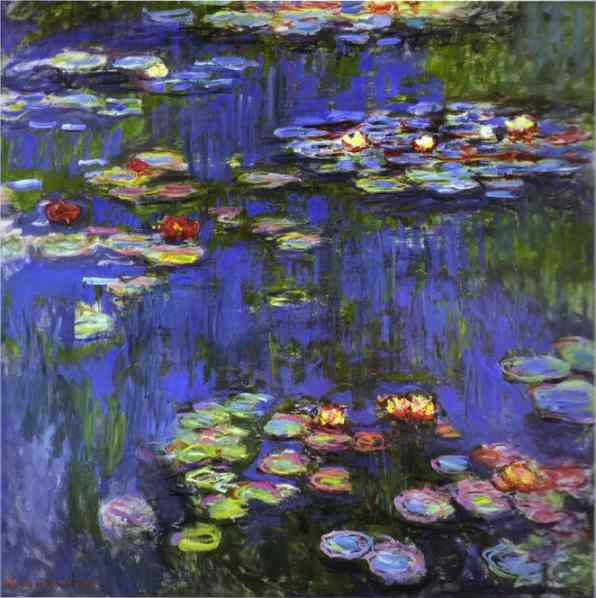
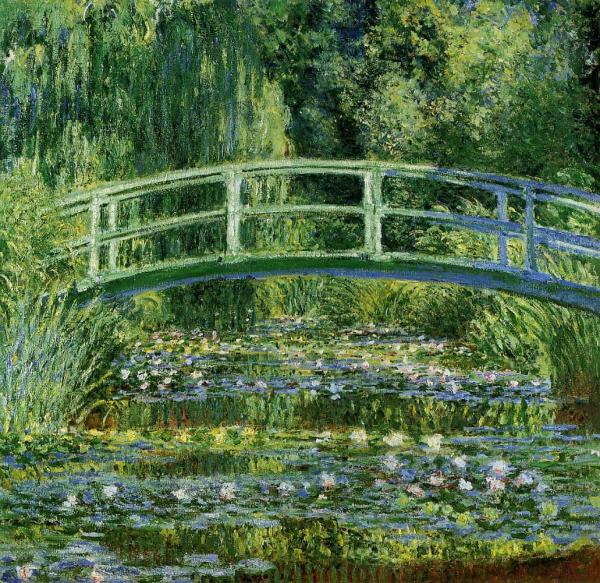
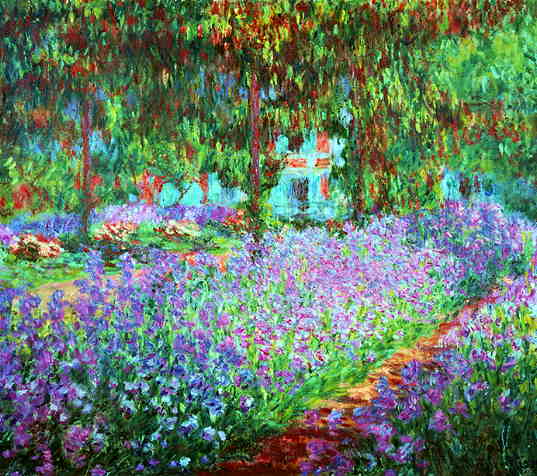
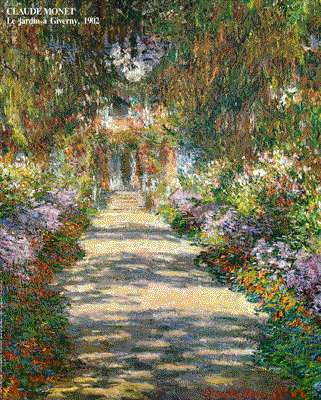
Monet was exceptionally fond of painting controlled nature: his own garden in Giverny, with its water lilies,
pond, and bridge. He also painted up and down the banks of the Seine.
Monet died 1926 at the age of 86.